
Whole Artist Mastery
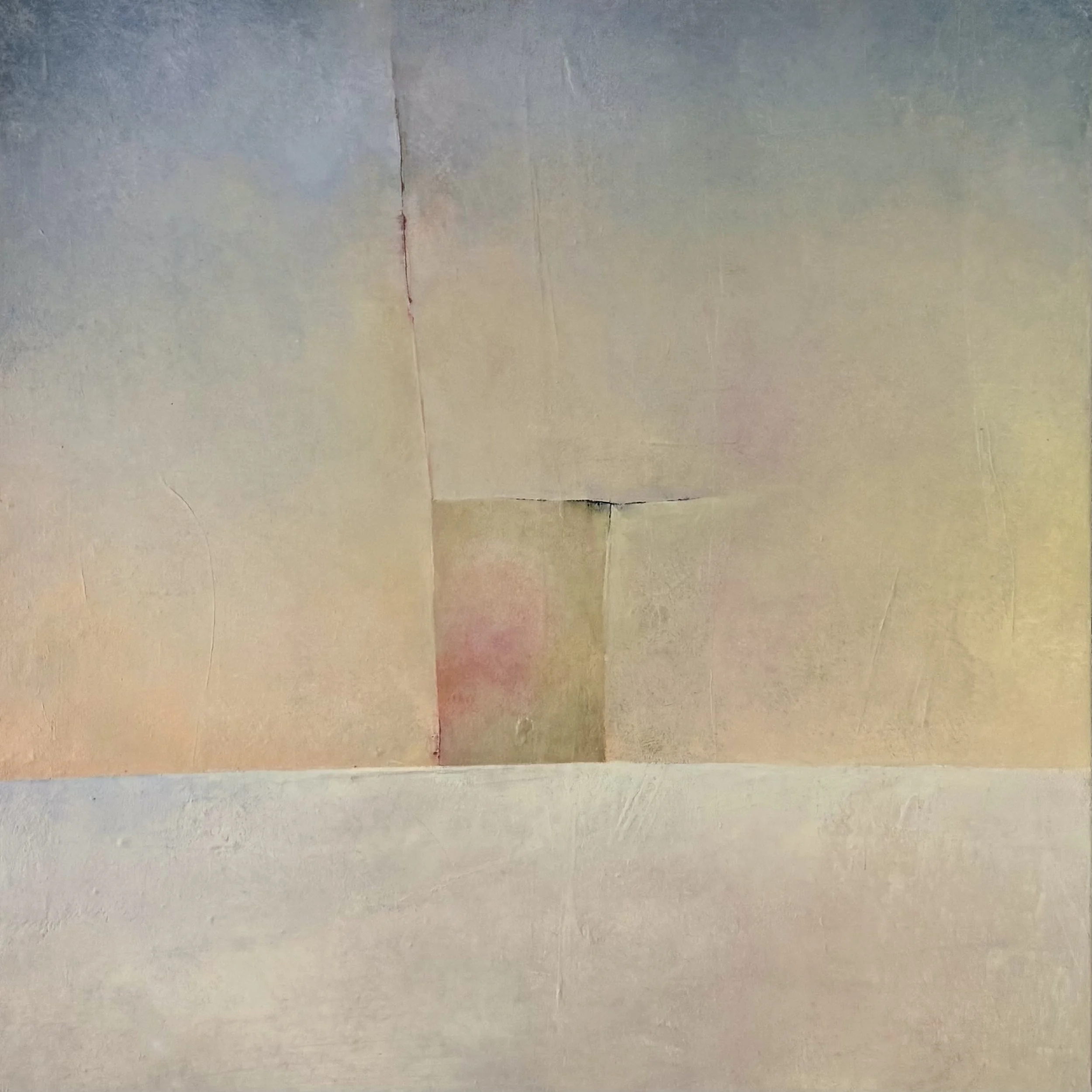
Listen Carefully, oil on panel, 36” sq.
Listen Carefully: Patience, Possibility Thinking, and the Courage to Change a Painting
Adapted from a live talk on process.
I completed two paintings in 2026, which these days is something of a major feat for me. I wanted to share them with my mentorship artists, and with those of you who are here because you're on my mailing list. I'm thrilled to have you.
I have many wonderful conversations with the artists I work with, and most of them focus on process. What does it take to start a painting and bring it to resolution? How do we navigate that process, both in how we think and in the decisions we make? And, as many of you have heard me say, the key tool in your back pocket is patience.
I am focusing on three ideas: how we move through our process, how we employ what I call possibility thinking as opposed to barrier-building thinking, and how patience is absolutely crucial to reaching the point where a painting makes your heart sing, where the only word for it is wow.
People can tell when that happens. I see it over and over: viewers respond to a painting that has emotional connection, intellectual engagement, and the physicality of the paint. When those three things are fully integrated, you can't pull them apart. There is a kind of transcendent experience beyond each individual element, a sense of awe in looking at the painting.
From 20 minutes to over a year
Over the last decade, I've gone from making paintings in 20, 40, or 60 minutes, with lovely colors and quick brushstrokes, to paintings that now take over a year.
The transformation came from pushing my own artistic growth. At a certain point, I got tired of making pretty paintings. I got tired of doing the same thing. Then what do you do? Conversations from the last couple of days are swirling in my mind: I just don't know what to paint anymore. I'm out of ideas.
The way I've found to move beyond that is to keep asking yourself questions, and to summon a great deal of courage to change a painting. Even if you love where it is, if something about it isn't working for you, you dive in and change the whole thing radically.
I'm going to walk you through how that worked in this painting, in the hope that it gives you inspiration and guidance for your own practice.
Painting: Listen Carefully
This is the painting that was accepted to the Salon des Beaux-Arts in Paris in mid-September, and it's the final piece. Before I show you where it began, take a moment to look at it. I'll hold off on pointing out any elements until later. Just take it in, and listen carefully to what the painting is telling you.
History of painting phases for Listen Carefully
This is the first stage, dated September 29th, 2024. (The dates don't always line up with when I worked on a painting, but this one does.)
My first reaction was: wow, I like this. Could this be finished?
I had been wanting to make more minimal compositions, and I was intrigued by working with just three shapes. The gray shape here is actually one shape, because it isn't split all the way to the top. That was part of the point: one shape that almost becomes two. I loved the movement.
But two things nagged at me.
The first was surface. All my previous paintings had reached a level of refinement and depth that this one fell short of. Once you reach that level of complexity in your surfaces, it's very hard, at least for me, to settle for less. I'm a professional practicing artist, and I need to show up with a consistent voice. What constitutes consistency is a whole other conversation, but right now, for me, it lives in the depth of the paint surface.
The second was that I speak all the time about the marriage of intellectual engagement through the composition, and emotional connection through color and mark. And I include the way the paint is applied, and the way an artist uses their tools so that the marks look as though they're coming from within the artist rather than from a particular tool.
My expert eye knew immediately that these marks were made mechanically, whether with a Bondo spreader, a squeegee, a catalyst (a lot of you use those). The tool was guiding my hand, rather than my hand guiding the tool. I really want you to hear that.
The trap of "I like it, but it's not finished"
So I thought: but I like it too much. I don't want to go any further, and yet I know I have to. Does that sound familiar? You like what you're looking at, you know it's not finished, and that can completely block you.
This is where the way you frame your questions matters. Compare these two ways of thinking:
"I know it has to move beyond here. What do I want to do with that?" or "I know it's unfinished and needs to continue on, but I have to figure out what that means for me." These invite me to keep going.
"I really like this. I don't know where to go from it. I don't want to change it, but I know it's not finished." This leaves me stuck.
I want you to hear the difference, because it's crucial to the success of a painting. Ask yourself questions that invite possibilities, rather than thinking in ways that keep you stuck.
Making it ugly
Here's another important point: I had to make it ugly. The next stage still wasn't it. I started working with what I had, mushing some of the lines, and then I realized it was less dynamic than where it had been. So I made it uglier, or at least that's my opinion of it.
I kept coming back to the idea of a red shape. That harkens back to the work I was making in the early 80s, after I lived in Japan for a year in 1982. The central element in all of my work then was a red square, sometimes hidden, sometimes partially hidden, sometimes fully in view. I wasn't consciously thinking about that, but it felt like something I'd really like to revisit.
Still, I didn't know where to go from there. And I kept telling myself, I don't know where to go from here, which kept me stuck.
Where patience comes in
The only way forward was to let the painting sit. This is where patience enters. Many of us, myself included, want a painting to just get there. We want to love it quickly. That is pretty much a recipe for it taking a lot longer. So I accepted that the painting was far from finished and that I needed to sit with it for a while.
Have the courage to be bold
When I came back, I made this area gray, but I didn't add gray. The black paint I used is very dry, with absolutely no medium in it, so I could let it just graze the top of the green. That turned the green gray, instead of introducing another color.
This is how the process of application led me to that moment of wow, this is it. For a while I thought: I love this. This little shape is talking to this little shape.
But by January 1st, things had shifted. (Around that time the year before, I had been dealing with a mild case of shingles. I wasn't feeling well, and this painting was what kept me going. I think some of that was playing into my decisions about color and what I wanted.)
The more I looked at it, the more it began to feel like a doorstop. When you look at it, does your eye go right to this spot? For me, it did.
So I needed to work with that. I went from there to a stage where the blue up here had gotten too blue. Maybe, given how I was feeling, it was just too blue for me. I grayed it down. Then I felt it needed a little more color and a little less of a shape down here.
And that is the finished piece, the one you saw at the very beginning.
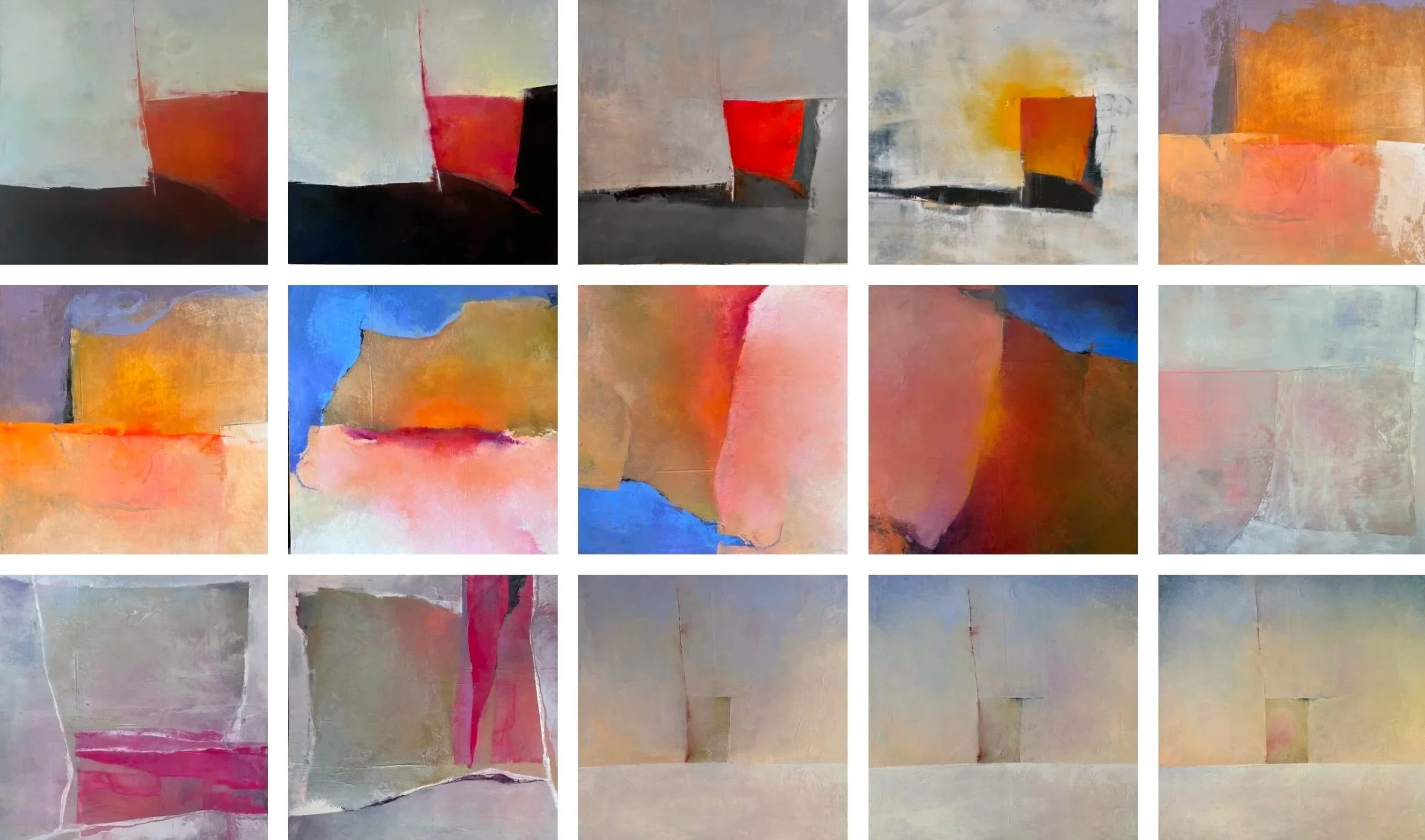
Painting Progression: Listen Carefully, oil on panel, 36” sq.
Takeaways
Use possibility thinking. Ask questions that invite you forward, not statements that keep you stuck.
Let your hand guide the tool. Marks should feel as if they come from within you, not from the tool.
Be willing to make it ugly. Sometimes you have to lose what you love to find what's next. Don’t be to precious
Practice patience. Wanting to love a painting quickly usually makes the journey longer.
Have the courage to change it radically, even when you love where it is. Be bold.
